Artificial Turf vs. Natural Grass in Kelowna: A Balanced Look
Artificial turf has become a serious conversation in Kelowna over the last several years. Water restrictions, high summer water bills, and the labour of lawn maintenance have pushed a lot of Okanagan homeowners to at least research the option. The question isn't whether artificial turf is worth considering. In some situations it clearly is. The question is whether the tradeoffs work for your specific yard, your use case, and your long-term plans for the property. Kelowna's climate makes this decision more nuanced than in cooler cities. The water restriction argument for artificial turf is real and meaningful here. Stage 2 restrictions limiting outdoor watering to 2 days per week genuinely strain natural lawns through July and August, and the stress shows. On that front, artificial turf wins clearly: once installed, it needs no irrigation. But Kelowna's other climate characteristic, intense summer heat, creates a problem that artificial turf proponents don't always advertise clearly. Synthetic turf in direct Okanagan sun in July can reach surface temperatures of 60 to 80°C. That's hot enough to cause burns on bare feet and paws, and it makes the surface genuinely unusable during peak summer heat. A natural grass lawn in the same conditions stays 20 to 30°C cooler because grass transpires moisture and doesn't absorb heat the same way. The cost comparison is also more complicated than the upfront number suggests. Artificial turf installed in Kelowna runs $15 to $25 per square foot. Natural sod installation costs $5 to $8 per square foot. The gap is substantial, but the long-term math on water savings, maintenance, and replacement cycles tells a more complete story. This guide gives you a balanced, specific look at both options for Kelowna's conditions. No single answer fits every yard. For [sod installation in Kelowna and the Okanagan](/services/sod-installation/kelowna/), or to talk through which option fits your property, call Cool Runnings at (250) 307-9220.
Upfront Cost: Artificial Turf vs. Natural Sod
Artificial turf installed in Kelowna runs $15 to $25 per square foot, depending on turf quality, infill type, and the complexity of the installation. That price includes the turf itself, the base preparation (excavating existing material, compacting crushed rock base, weed barrier), and installation. On a 500 square foot backyard, you're looking at $7,500 to $12,500. On a 1,000 square foot lawn, $15,000 to $25,000. These are not small numbers.
Natural sod installed professionally in Kelowna runs $5 to $8 per square foot, including site prep, sod material, delivery, and installation. A 500 square foot backyard costs $2,500 to $4,000. The same 1,000 square foot lawn costs $5,000 to $8,000. That's roughly one-third the cost of artificial turf.
The upfront gap is significant. Most homeowners who go the artificial turf route justify it through long-term water and maintenance savings. That math can work, but it depends on your water costs and the size of the area. For a small side yard (200 square feet or less), the water savings over 15 years might not cover the premium. For a large water-thirsty front lawn (800 to 1,200 square feet) in a family home with a large irrigation system, the savings are more substantial.
Another cost to factor in: artificial turf doesn't last forever. Quality turf carries a 15 to 20 year warranty, but real-world performance varies. Turf in high-traffic areas (play areas, dog runs) wears significantly faster. Replacement at the 12 to 15 year mark is not uncommon for high-use areas. That replacement cost is another $15 to $25 per square foot, so the long-term cost picture depends heavily on your specific use case.
For the most accurate comparison, get a site-specific sod quote from Cool Runnings alongside any artificial turf quote you receive.
Some municipalities and strata complexes in the Kelowna area have restrictions on artificial turf in front yards for aesthetic and drainage reasons. Check with the City of Kelowna or your strata before committing to an artificial turf install.
Surface Heat in Okanagan Summers: A Real Concern
This is the factor that surprises most Kelowna homeowners who have only researched artificial turf from national sources. Synthetic turf absorbs and radiates heat in a way that natural grass does not. In direct Okanagan sun in July and August, artificial turf surface temperatures routinely reach 60 to 80°C. That's not an exaggeration. University studies and field measurements consistently show synthetic turf reaching temperatures 40 to 60°C higher than the surrounding air temperature on hot days.
To put that in context: 60°C is hot enough to cause a burn on bare skin after a few seconds of contact. It's also hot enough to burn dog paw pads. Kelowna's summer regularly produces ambient temperatures of 35 to 40°C, which means artificial turf surfaces can reach 75 to 80°C. This is not a theoretical risk.
The practical consequence is that a south-facing artificial turf lawn in Kelowna is not usable for kids or pets during peak summer hours (typically 11am to 6pm). Natural grass under the same conditions stays significantly cooler. Grass transpires water and provides an evaporative cooling effect. Even in drought stress, natural grass surface temperatures are rarely more than 15 to 20°C above ambient.
Some artificial turf manufacturers offer infills designed to reduce heat absorption, including coated sand, zeolite, or organic cork infills. These reduce surface temperatures by 15 to 20°C compared to standard crumb rubber infill, but do not eliminate the heat problem entirely. In Kelowna, even the better infill products still produce surfaces that get uncomfortably hot during peak summer heat.
If your primary goal is a play area for children or a space for dogs to use freely through the summer, this heat factor is a strong argument for natural grass, even accounting for watering costs and restrictions.
Artificial turf surface temperatures in Kelowna's July heat can exceed 70°C in direct sun. If you have dogs or young children, test any installed turf by pressing your palm to the surface on a hot afternoon before allowing them to use it.
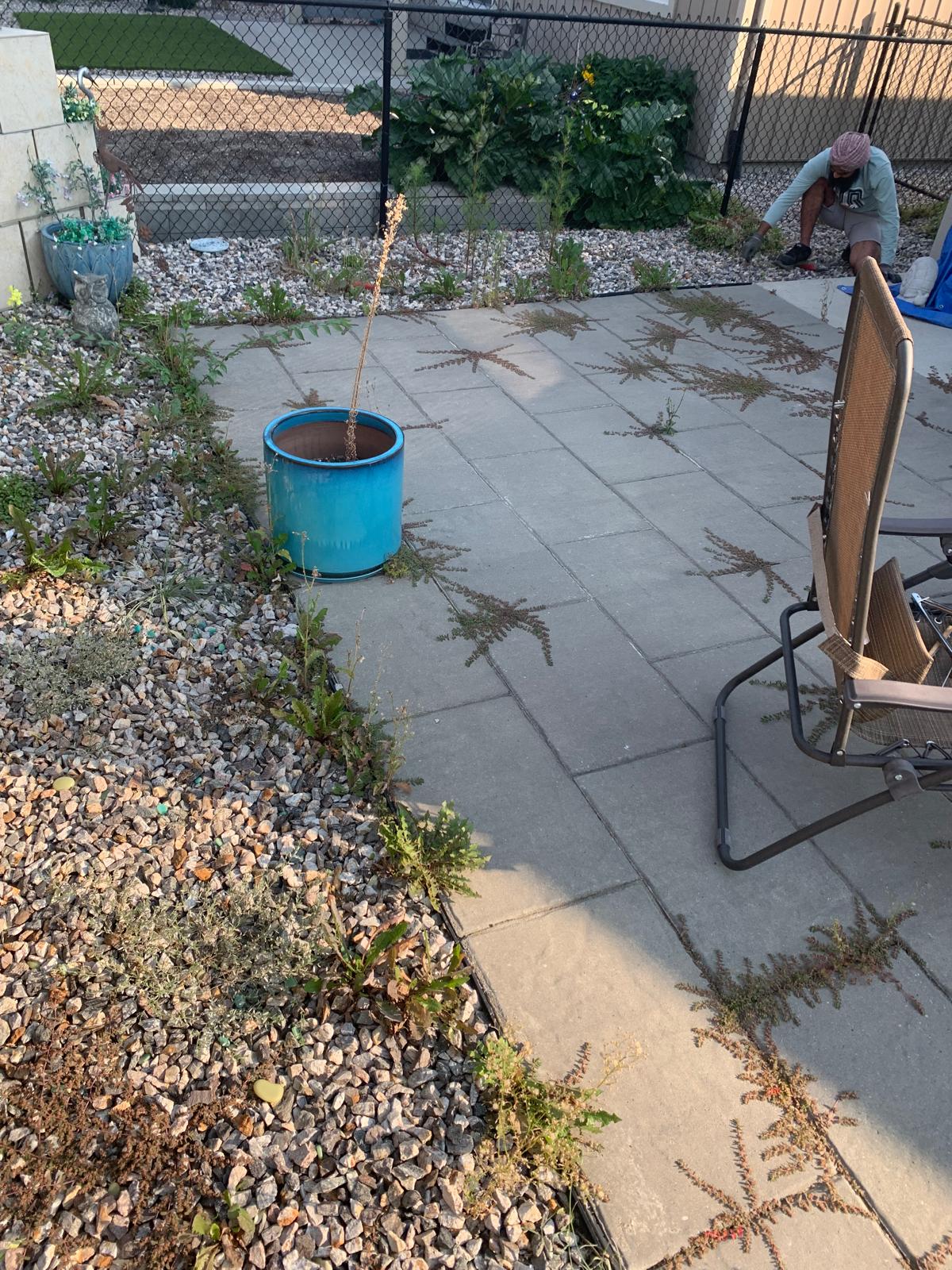 Before
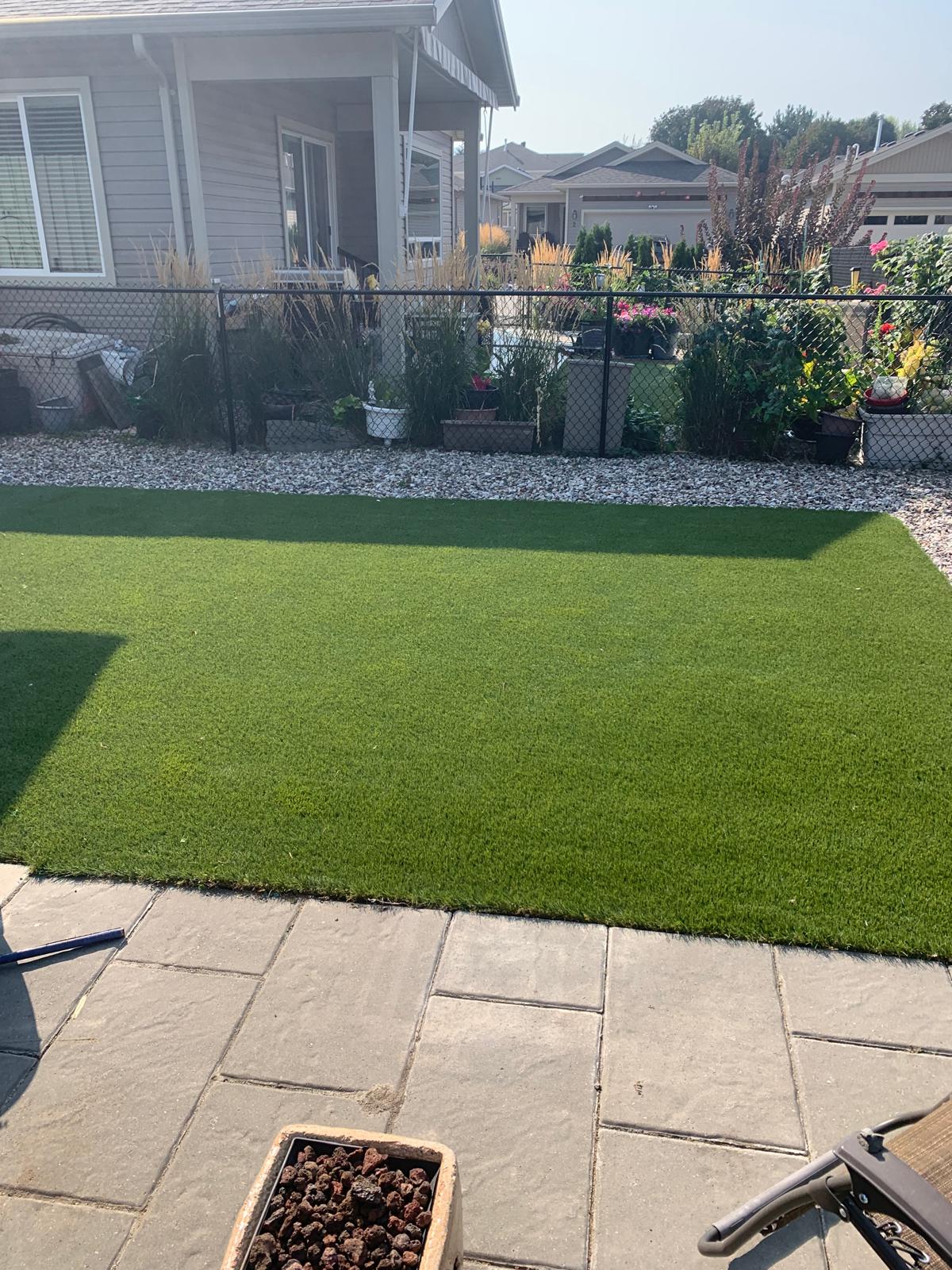 After
After
Water Restrictions and the Argument for Artificial Turf
The water restriction argument for artificial turf in Kelowna is the strongest one available. Stage 2 restrictions, which the City of Kelowna typically implements by early to mid-July, limit outdoor irrigation to 2 days per week with specific time windows. That schedule is not sufficient to maintain a healthy natural lawn through a Kelowna July and August. Most natural lawns go into partial or full dormancy during Stage 2, turning brown until restrictions ease and fall rains return.
Artificial turf requires no irrigation after installation. It stays green regardless of water restrictions. For homeowners who find the brown-lawn summer experience aesthetically frustrating or who have HOA or strata expectations for green lawns, artificial turf solves that problem completely.
The water savings over the life of the turf are real. A 1,000 square foot natural lawn in Kelowna during a typical season uses roughly 50,000 to 80,000 litres of water between May and September. At current Kelowna water rates, that's $80 to $150 per season in water costs for that lawn alone. Over 15 years, that's $1,200 to $2,250 in water savings from a single lawn area. On its own, that doesn't close the cost gap between artificial turf and sod. But combined with eliminated mowing costs (if you were paying for lawn service) and reduced fertilizer and treatment costs, the total savings over 15 years can reach $3,000 to $6,000 on a medium-sized lawn.
The water restriction argument is strongest for ornamental lawns that aren't primary play areas: front yards, side yards, and areas that exist primarily for appearance rather than active use. For those applications, artificial turf's water savings and consistent appearance are genuine advantages. See our lawn care service page for context on what maintaining a natural lawn in Kelowna typically involves.
GEID (Glenmore-Ellison Improvement District) and the City of Kelowna impose water restrictions independently. If you're outside city limits, check your specific water provider's restrictions. Some rural areas have more severe restrictions than the city.
Environmental Considerations
The environmental picture for artificial turf is more complicated than either advocates or critics typically present. The honest summary is that both artificial turf and natural grass have environmental tradeoffs, and the right answer depends on which factors matter most to you.
Artificial turf eliminates the need for mowing (reducing fossil fuel use from gas mowers), eliminates fertilizer and pesticide applications (reducing chemical runoff), and eliminates irrigation water use. Those are real environmental wins, and they're not insignificant.
On the other side, artificial turf is made from petroleum-derived polymers. It does not biodegrade at end of life and recycling options are limited. The most common infill, crumb rubber (recycled tires), has been the subject of ongoing research regarding microplastic release and chemical leaching. Newer organic and sand infills address some of these concerns but are more expensive and require more frequent replacement.
Artificial turf also provides no carbon sequestration. A healthy natural lawn sequesters a modest amount of carbon in soil organic matter. It provides habitat for soil biology and beneficial insects in ways synthetic surfaces cannot. The soil underneath artificial turf compacts over time and loses biological activity.
For water in a semi-arid environment like the Okanagan, the calculus often favours artificial turf from a pure water conservation standpoint. BC's Interior faces increasing drought pressure, and outdoor irrigation is a significant component of residential water use. Reducing that use has real regional environmental value.
The decision comes down to which environmental factors you weight most. Water conservation in a drought-stressed region, or avoiding microplastic materials and preserving soil biology. There's no universal right answer.
If you're installing artificial turf and concerned about microplastics, ask your installer specifically about organic infill options (cork, coconut fibre, or zeolite sand blends). These are more expensive but don't carry the same concerns as crumb rubber derived from recycled tires.
Pet and Family Use: Where Each Option Performs
How you use your yard matters as much as anything else when comparing artificial turf and natural grass. A yard that exists primarily for appearance has different requirements than one that's used daily by kids and dogs.
For pets, the heat issue with artificial turf in Kelowna is a genuine barrier during peak summer. Dogs who use a south-facing turf area freely in July risk paw pad burns. You can manage this by watering the turf surface before use to cool it down (which partly offsets the water savings argument) or by only allowing use during cooler morning and evening hours. Natural grass stays much cooler and most dogs can use it freely through the day.
Artificial turf does make pet waste management easier in some ways. Urine drains through the backing, and solid waste is easy to remove. However, turf used heavily by dogs develops odour over time as waste accumulates in the infill. This requires periodic rinsing and infill replacement, which adds to maintenance cost and complexity.
For kids' play areas, the heat consideration applies equally. Natural grass is safer during peak Kelowna summer heat. Artificial turf is excellent for fall, spring, and cooler summer days and is more durable under heavy foot traffic than natural grass.
Natural grass self-repairs from wear damage over time if the base is healthy. Artificial turf in high-traffic areas (goal mouth on a soccer area, a path dogs use daily) shows visible wear and eventually needs replacing. Planning for higher-wear areas is worth doing before installation.
The family-use sweet spot for artificial turf is the low-to-medium use area: a side yard that sees occasional traffic, a front lawn that's mostly decorative, or a rental property lawn that needs to look good with minimal maintenance. For the primary family play area, natural grass still performs better in Kelowna's summer conditions.
If you have dogs on artificial turf, plan on rinsing the surface weekly during summer to control odour. Some Kelowna turf installers offer enzyme treatments that help break down pet waste residue in the infill.
Resale Value and the Bottom Line Decision
Resale value is a legitimate factor in the artificial turf decision for Kelowna homeowners who may sell within the next 10 to 15 years. The research on how artificial turf affects home sale prices is mixed. In water-restricted areas, some buyers see artificial turf as a positive: low maintenance, always green, no watering costs. Other buyers, particularly those with young children or dogs, may see it as a negative and price that into an offer.
Real estate agents in Kelowna generally report that artificial turf in front yards is neutral to slightly negative with conventional buyers, and neutral to slightly positive with buyers specifically looking for low-maintenance properties. It's not a feature that commands a premium the way a kitchen renovation does.
Natural grass in good condition is generally seen as neutral and expected. It doesn't add or subtract value on its own. A maintained natural lawn is the baseline expectation most buyers bring.
The honest bottom line for Kelowna specifically: artificial turf makes financial and practical sense for low-use side yards, front yards where appearance and low maintenance are priorities, and rental or investment properties where minimizing maintenance costs is the goal. Natural grass remains the better choice for primary family and pet-use areas, given Kelowna's surface heat problem with turf in summer.
The middle ground that works well on many Okanagan properties: natural grass in the backyard where family and pets use it, artificial turf or rock in the front yard or side yards where the area is primarily decorative. This approach gives you the usable natural grass where it matters and the low-maintenance benefits of artificial or rock in areas where the heat issue is less critical.
For sod installation in Kelowna or to discuss what makes sense for your yard, contact Cool Runnings at (250) 307-9220.
Before installing artificial turf, get a written quote for the base preparation specifically. A proper artificial turf base requires excavating 4 to 6 inches of existing material, compacting a crushed rock sub-base, and installing drainage correctly. Cutting corners on the base leads to drainage problems and uneven surfaces within a few years.
How to Decide Between Artificial Turf and Natural Grass for Your Kelowna Yard
A practical framework for Kelowna and Okanagan homeowners comparing artificial turf installation against natural sod.
Common Questions
How hot does artificial turf get in Kelowna summers? ▾
How much does artificial turf cost to install in Kelowna? ▾
Does Kelowna's water restriction support artificial turf? ▾
Is artificial turf bad for dogs in Kelowna? ▾
What is the lifespan of artificial turf in Kelowna? ▾
Ramoy Brissett is the owner and lead landscaper at Cool Runnings, which he founded in 2017. With 9+ years of hands-on experience working in the Okanagan Valley's unique semi-arid climate, he personally oversees every job the company takes on. His expertise covers lawn care, sod installation, drought-tolerant planting, mulch and drainage, and full-yard renovations across Kelowna, West Kelowna, Vernon, Penticton, and Salmon Arm.
More about Ramoy →