Drought-Tolerant Landscaping in the Okanagan: What Works, What It Costs, and How to Get Started
The Okanagan gets around 300mm of rain per year. For context, that's less than Phoenix, Arizona gets in an average year. The land here is genuinely semi-arid, and most of the residential landscaping installed in the valley over the past few decades was designed as if we had the rainfall of the Lower Mainland. Water restrictions, climate trends, and a few expensive water bills have a lot of homeowners reconsidering that approach.
Why Water-Wise Landscaping Makes Sense in the Okanagan
The case for drought-tolerant landscaping in Kelowna and surrounding communities isn't complicated. We live in a semi-arid valley. The City of Kelowna has had water restrictions in effect every summer for years, and those restrictions are getting stricter, not looser, as the valley's population grows. A thirsty lawn and water-hungry garden beds are genuinely out of step with local water supply realities.
There's also the cost angle. Irrigation accounts for a large portion of household water use in summer. Homeowners who convert even a portion of their yard to low-water landscaping see meaningful reductions in their water bills, and they stop worrying about whether they're compliant with the current restriction stage.
Wildfires have changed the conversation too. FireSmart BC's principles push toward non-combustible materials and plants with lower moisture content near structures. Drought-tolerant plants, by nature, tend to have lower fuel loads than lush, heavily irrigated plantings. Water-wise landscaping and fire-smart landscaping overlap in useful ways, particularly in Kelowna's hillside and interface neighbourhoods.
For planting and landscaping in Kelowna, drought-tolerant conversions have become one of the most common project types we take on.
The City of Kelowna's WaterSmart program offers rebates and resources for homeowners converting to low-water landscaping. Check their website for current incentives before you start planning.
Plants That Actually Thrive Here
The best drought-tolerant plants for the Okanagan are the ones that have already proven they can handle 35°C summers, cold winters, and months without rain. Here's what I see performing well across properties in the valley.
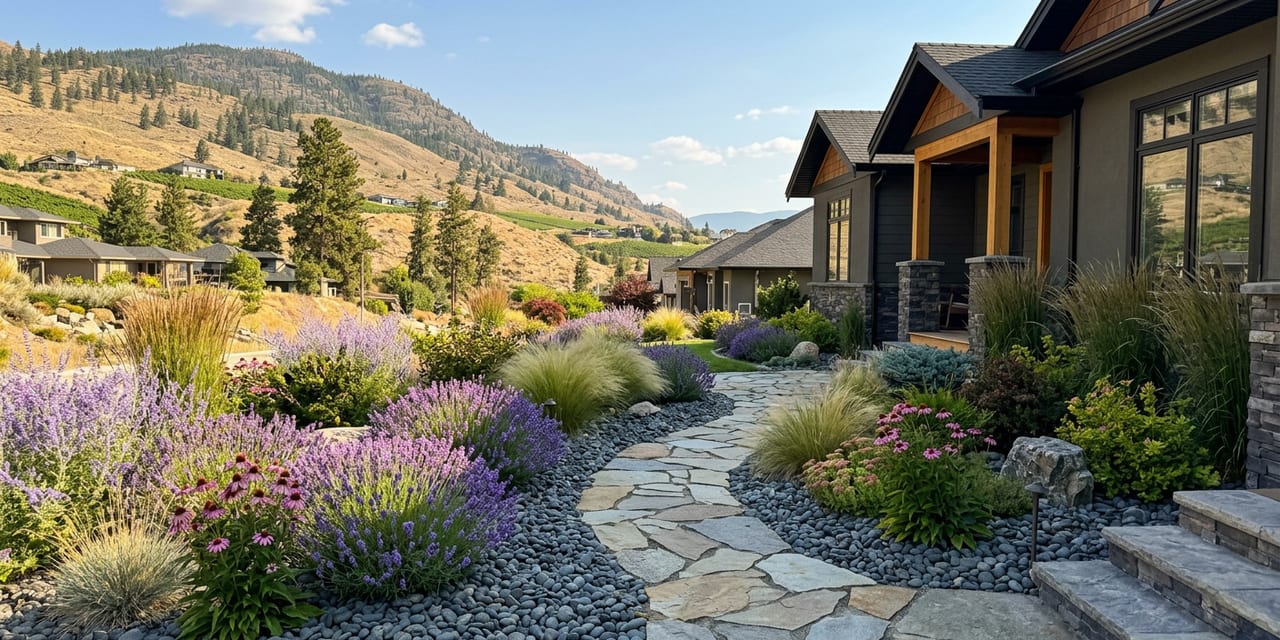
Lavender is probably the most bulletproof choice. It loves our dry heat, thrives in poor sandy soil, looks incredible in July and August when half the valley is brown, and the deer mostly leave it alone. English lavender varieties are hardiest for our winters.
Russian Sage is similar in hardiness and just as good in a dry border. It flowers from midsummer through fall in soft blue-purple, gets quite large (give it space), and practically thrives on neglect once established.
Blue Fescue (ornamental grass) works well as a low-edging plant or in mass plantings. It forms tidy mounds, holds its form year-round, and handles Okanagan conditions without any supplemental irrigation once established.
Creeping Juniper is a low-maintenance ground cover that spreads to fill large areas. Excellent on slopes where erosion is a concern. Completely drought-tolerant once established.
Potentilla is one of the most reliable flowering shrubs in the Interior. Blooms for months, handles cold and heat, minimal water needed.
Black-Eyed Susan, Yarrow, and Sedum fill out a perennial border with colour and require almost no irrigation after the establishment year. All three are also native or near-native to this type of climate.
For a native choice with real visual impact, Saskatoon Serviceberry is excellent. It flowers in spring, produces edible berries in summer, and turns good fall colours. Completely adapted to our conditions.
For a full searchable database of plants suited to the Okanagan, the Okanagan Xeriscape Association (OXA) maintains an excellent plant reference at okanaganxeriscape.org. It's the best local plant resource available.
For planting and landscaping work across the Okanagan, we select plants based on your specific site conditions, sun exposure, and soil type, not just a generic list.
OXA's plant database (okanaganxeriscape.org) lets you filter by water needs, sun exposure, and plant type. It's the best local plant reference available and worth bookmarking.
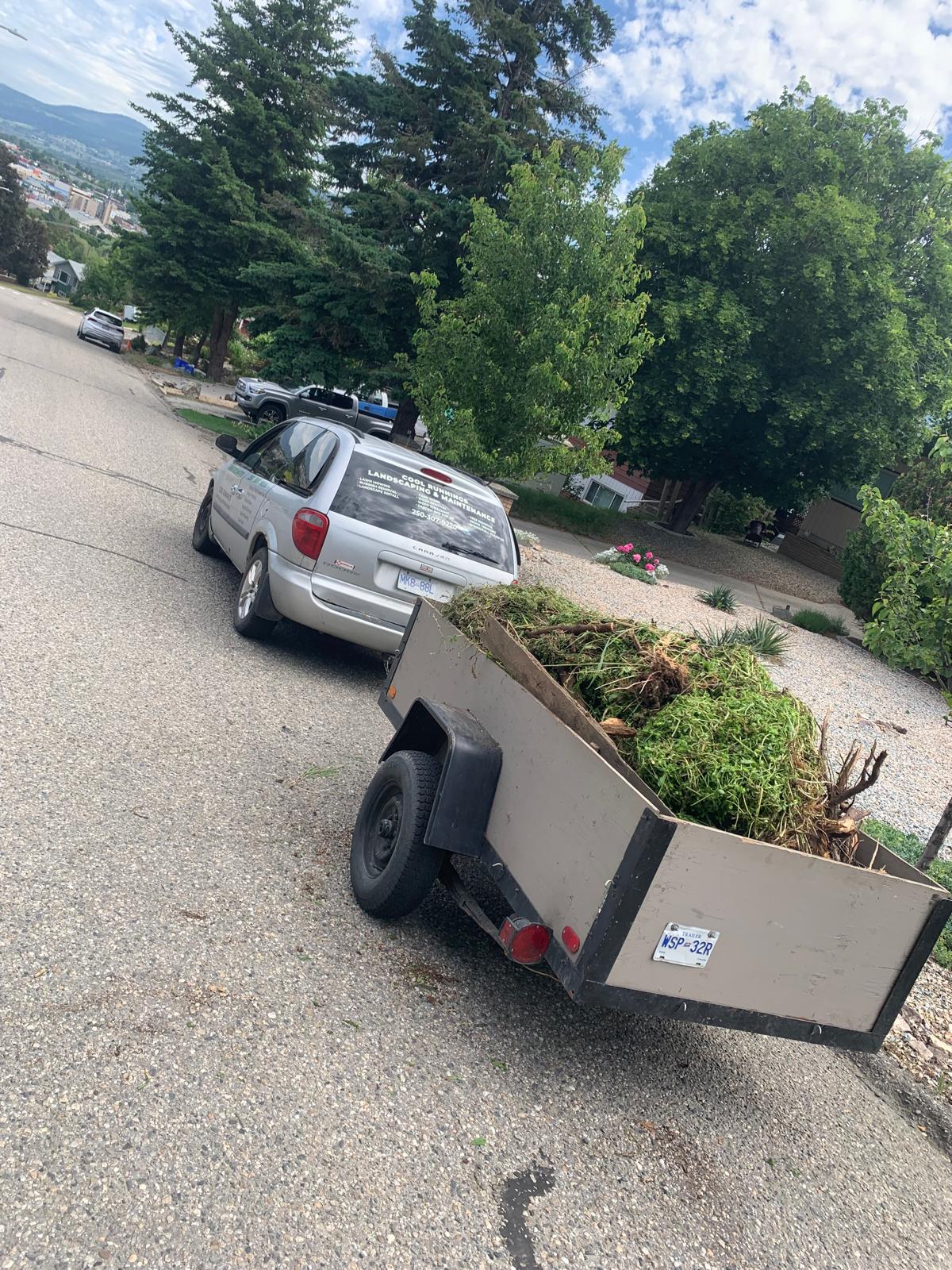 Before
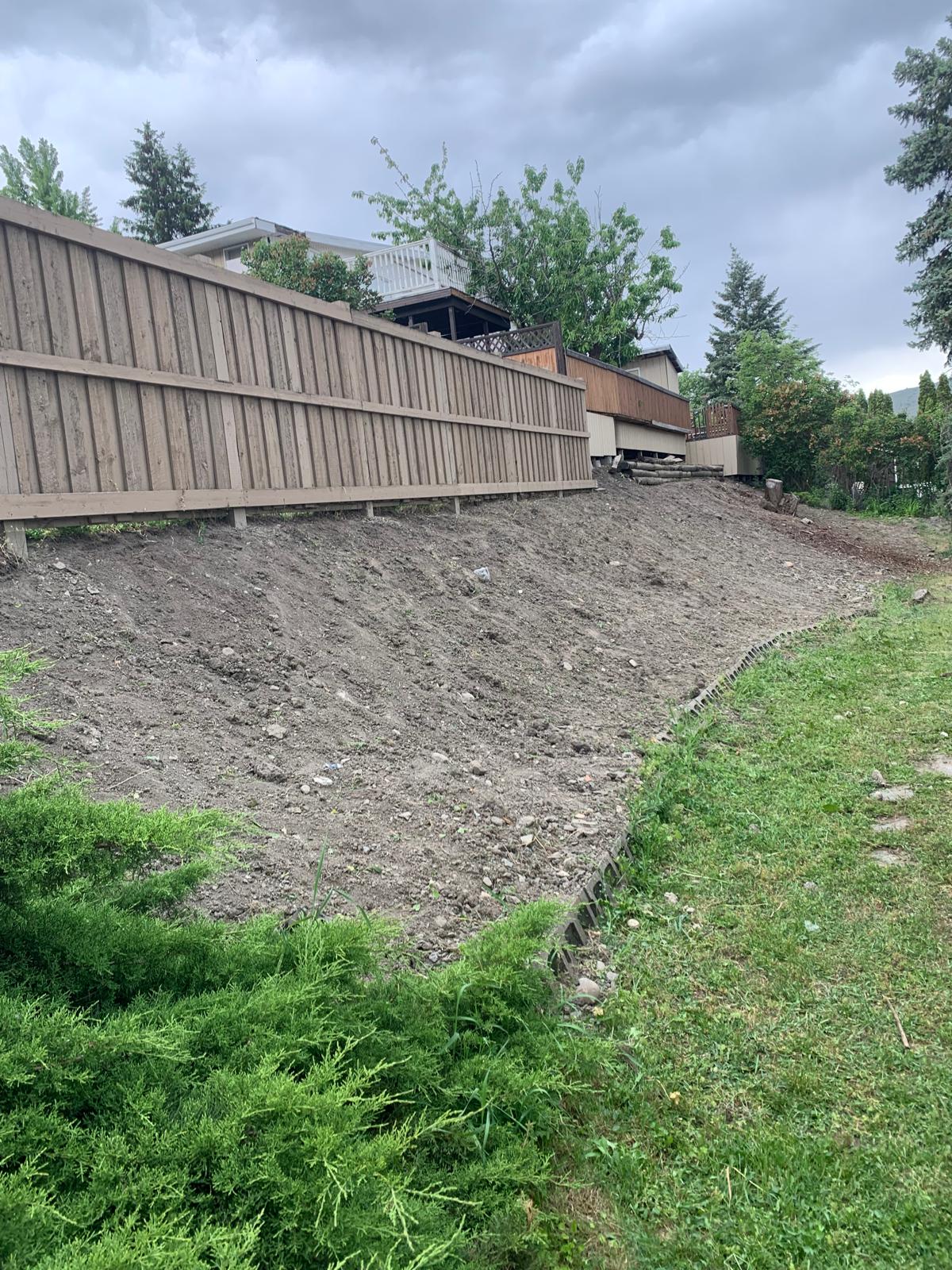 After
After
Ground Cover That Replaces Thirsty Lawn
Lawn is the biggest water user in most residential yards. A full Kentucky bluegrass lawn needs around 2.5 to 4cm of water per week in Okanagan summers to stay green, that's a lot to ask from a restricted system. Many homeowners are replacing lawn areas, particularly in the front yard, with ground covers that need a fraction of the water.
River rock with weed fabric underneath is the most popular low-maintenance replacement. Paired with drought-tolerant plants and clean edging, it looks sharp and requires almost no upkeep. It's also non-combustible, which matters in WUI neighbourhoods. Rock and mulch installation in Kelowna is one of the most common requests we get from homeowners converting away from lawn.
Decomposed granite is another popular option. It compacts slightly, has a natural muted colour that suits the Okanagan palette, and allows some drainage. Good choice for larger flat areas or pathways.
Creeping Thyme is worth mentioning as a living ground cover option. It's walkable, flowers in summer (bees love it), handles dry conditions well, and smells good underfoot. In small areas or between stepping stones, it's a lovely alternative to grass. It does need occasional watering to get established, but once it is, it largely takes care of itself.
Ornamental gravel and river rock also pair well with larger specimen plants, giving the finished space a design coherence that plain rock alone doesn't always achieve. Good landscaping is in the details of how materials are combined.

What It Costs to Convert
The honest answer is that costs vary widely depending on what you're replacing, what you're installing, and how much prep work the site needs. That said, here are realistic ranges for the Okanagan.
A small garden bed conversion (around 20 to 30 square metres), removing existing plants and sod, installing weed fabric, adding drought-tolerant plants and rock or mulch, typically runs $500 to $1,500. This assumes straightforward access and no major soil amendment work.
A full front yard conversion (replacing lawn with drought-tolerant planting, rock, and new edging) typically runs $2,000 to $6,000 or more, depending on yard size, material choice, and plant selection. Premium materials (natural river rock, larger specimen plants) push costs higher. A clean, well-executed conversion with quality plants and proper fabric installation is worth the investment, it should last a decade with minimal maintenance.
For planting and landscaping in Kelowna combined with rock and mulch installation, we typically quote these together so you get accurate numbers for the full scope.
Soil preparation matters a lot to the long-term outcome. In parts of the Okanagan where the soil is very sandy or has very low organic content, a light amendment before planting makes a real difference in how quickly plants establish. We'll flag this in a site quote if it applies to your property.
Costs in the Okanagan have risen with material and labour prices across BC. Any quote you received two or three years ago will need to be revisited. Get a current assessment before planning your budget.
Kelowna Water Restrictions: A Quick Primer
If you own property in Kelowna and water any outdoor plants, you need to know how restrictions work. The City of Kelowna's water restrictions apply from June 1 to September 15 each year at Stage 1 minimum. Stage 2 is triggered when reservoir levels drop to a specified threshold, which happens most summers.
Stage 1: Odd/even day watering based on your address. No irrigation between 10am and 7pm. Irrigation systems and sprinklers only on your scheduled day.
Stage 2: Three days per week maximum. The same timing restrictions apply. Hand watering of vegetables and new plantings is generally still allowed daily, but check the specific rules when Stage 2 is in effect as they can be updated.
New plantings get a 21-day exception in most years to allow for establishment watering, but you need to display a watering notice on the plant to be in compliance. Newly installed sod typically has a similar grace period.
Drought-tolerant landscaping removes most of this stress. Plants established for a full season need very little supplemental irrigation, and in a water-wise garden you're mostly hand-watering new additions in their first year. No schedule-checking, no restriction anxiety.
West Kelowna, Lake Country, and other Okanagan communities have their own restriction bylaws that generally follow similar structures. Check your municipality's current stage before irrigating during summer.

Working With a Landscaper vs. DIY
A lot of drought-tolerant landscaping work is DIY-friendly, especially if you're replacing a small bed or adding a few plants to an existing space. Planting, mulching, and basic rock installation are accessible for motivated homeowners with a weekend and the right materials.
Where a landscaper adds value is in the planning and prep. Plant selection that's actually suited to your specific site (sun exposure, soil drainage, deer pressure in your neighbourhood) makes a big difference in outcome. A garden that looks good in year one because you picked the right plants for the conditions is much more satisfying than one where half the plants struggled and needed replacing.
Soil preparation and drainage work often benefits from professional assessment too. Installing weed fabric incorrectly, overlapping the wrong direction relative to water flow, using material that's too thin, not pinning edges properly, leads to weeds emerging through gaps within a season or two.
For larger projects, the efficiency argument is real. Renting or borrowing a sod cutter, hauling material, and spending multiple weekends on a full front yard conversion costs more in time than most people expect. A crew that does this regularly can complete in a day what takes a homeowner a week.
For planting and landscaping across the Okanagan, Cool Runnings handles everything from plant selection and soil prep through installation and cleanup. Get in touch to talk through your project.
Even if you plan to do the work yourself, a one-hour consultation with a local landscaper before you start can save you from expensive plant selection mistakes and help you sequence the work correctly.
How to Convert a Garden Bed to Drought-Tolerant Landscaping
Converting a traditional garden bed to a drought-tolerant planting is a project most homeowners can tackle, with the right sequence and materials.
Common Questions
What are the best drought-tolerant plants for Kelowna BC? ▾
Does drought-tolerant landscaping look good, or does it look like rocks and dead stuff? ▾
How much does it cost to redo a front yard in the Okanagan? ▾
Does drought-tolerant landscaping need any water? ▾
When is the best time to plant drought-tolerant plants in Kelowna? ▾
How do Okanagan water restrictions affect drought-tolerant gardens? ▾
Should I hire a landscaper for drought-tolerant landscaping or can I DIY it? ▾
Ramoy Brissett is the owner and lead landscaper at Cool Runnings, which he founded in 2017. With 9+ years of hands-on experience working in the Okanagan Valley's unique semi-arid climate, he personally oversees every job the company takes on. His expertise covers lawn care, sod installation, drought-tolerant planting, mulch and drainage, and full-yard renovations across Kelowna, West Kelowna, Vernon, Penticton, and Salmon Arm.
More about Ramoy →