
Peachland Lawn Care Checklist: Spring Prep Guide for Okanagan Homeowners
Spring in Peachland arrives on its own schedule. Peachland is one of the warmer communities in the valley. Last spring frost typically falls around April 10-15, giving a longer growing season than Kelowna. That means the spring prep window between snowmelt and peak growing season is shorter than it feels, and getting the order of operations right avoids redoing work or missing the best planting and installation windows. This checklist is built for Peachland and the surrounding area, not generic advice written for Vancouver or Southern Ontario. The timing, the water restriction context, and the climate zone notes reflect [lawn care conditions in Peachland](/services/lawn-care/peachland/) specifically. Work through this in order — some tasks create the conditions for others to work properly, and jumping ahead costs time. If you're managing a full property refresh and want professional help with any part of this, Cool Runnings serves Peachland and provides free estimates. Call or text (250) 307-9220.
Step 1: Assess Before You Act
The first job every spring is a proper walk of your property before you do anything else. This sounds obvious but most homeowners skip straight to raking or scheduling work without noting what actually needs attention.
Walk the full perimeter and document:
- **Bare or thin patches**: These need overseeding or sod before the growing season, not after. Any patch thinner than 50% of normal density should be marked for treatment. - **Compaction areas**: High-traffic zones (pathways, near gates, dog runs) will have compacted soil. Note them for aeration timing. - **Drainage problems**: Standing water after snowmelt or rain indicates drainage issues that should be addressed before summer irrigation begins. - **Thatch buildup**: Run your fingers through the turf. More than 1.5cm (half an inch) of thatch indicates the lawn needs dethatching before fertilizer will penetrate properly. - **Weed pressure**: Early dandelions and creeping Charlie emerging before the grass greens up are easier to spot and treat in April than in June when everything is growing.
In Peachland's Zone 7a climate, don't start mowing or aerating until daytime temperatures are consistently above 10°C and the soil has dried out from snowmelt. Peachland is one of the warmer communities in the valley. Last spring frost typically falls around April 10-15, giving a longer growing season than Kelowna.
Peachland's warmer microclimate means longer summers but also more pressure on water use. Summer restrictions apply through the peak heat period.
Step 2: First Mow and Edge Cleanup
Your first cut of the season sets the baseline for the year. Don't rush it.
**Wait for the right conditions**: Soil should be firm (not spongy from snowmelt) and the grass should show clear green growth, not just be thawing out. In Peachland, this typically means mid-April in a normal year.
**Set blade height**: The first cut of the year should be slightly shorter than your summer height — around 6cm (2.5 inches) — to remove dead top growth and expose the crown. After the first cut, raise to your normal summer height of 7.5-8cm (3 inches).
**Sharpen your blade**: A dull blade tears grass rather than cutting it cleanly. Torn grass tips turn yellow and invite disease. Have the blade sharpened over winter or at the start of the season — it makes a visible difference in lawn appearance.
**Edge before you mow**: Reestablishing the turf edge along driveways, sidewalks, and garden beds is easier when the grass isn't long. A sharp half-moon edger or stick edger creates a clean line that the string trimmer maintains through the season.
**Service your mower**: Oil, air filter, spark plug, and blade sharpness. A reliable mower that starts first pull saves frustration all season. If it needs service, drop it off in March before the spring rush backs up equipment shops for weeks.
Don't scalp the lawn with an aggressive first cut. Removing more than one-third of the blade height in one session shocks the grass. If the lawn is tall from neglect, take it down in two passes a week apart rather than one drastic cut.
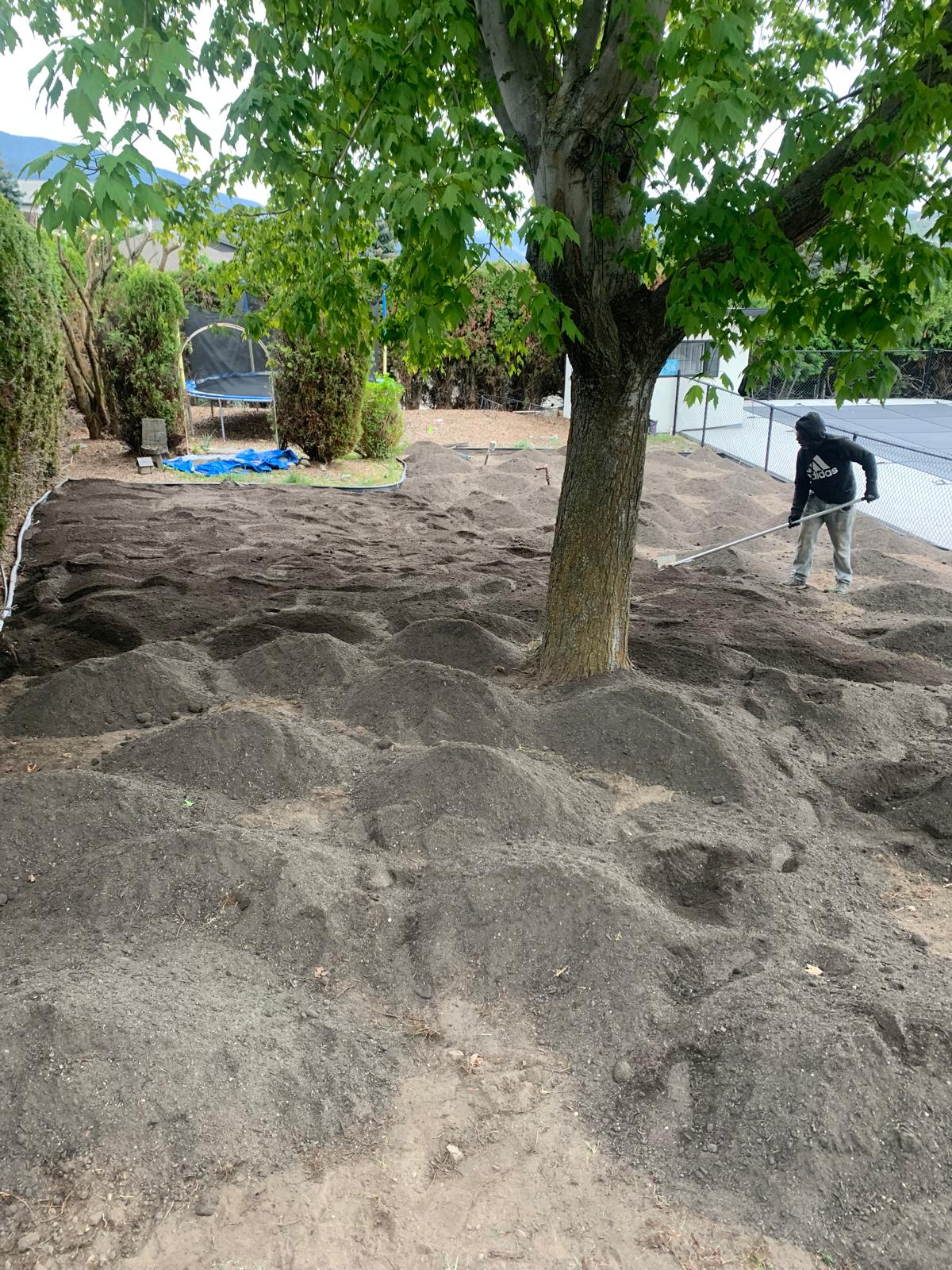 Before
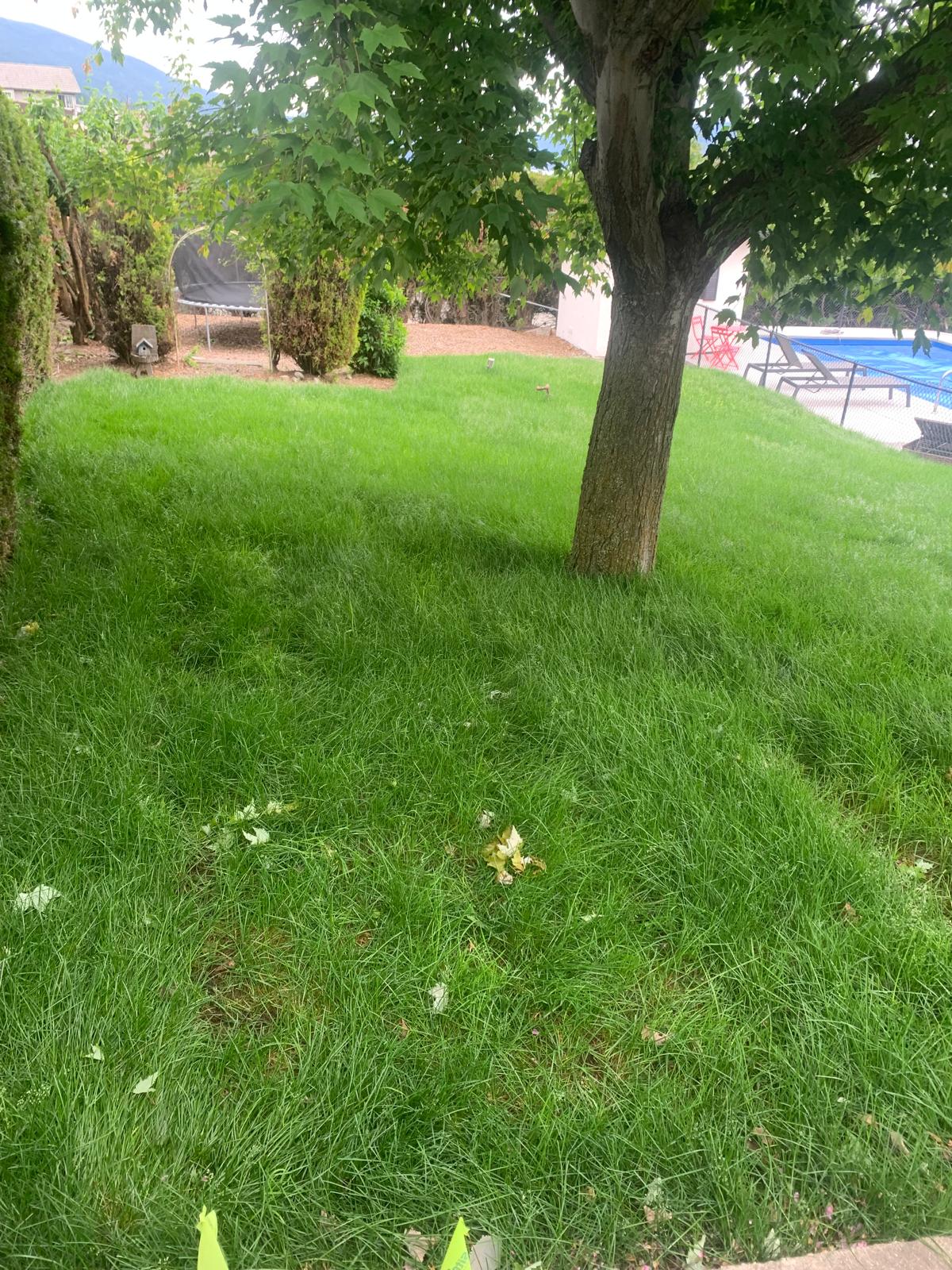 After
After
Step 3: Fertilize at the Right Time
Fertilizer timing matters more than the fertilizer itself. Applying nitrogen to cold soil in early April doesn't improve your lawn — the grass can't use it, it washes into groundwater, and it encourages tender growth that frost will damage.
**Spring application timing**: Apply the first fertilizer once soil temperature has reached 10°C and the lawn is actively growing. In Peachland, this is typically mid-May. A light, balanced slow-release product is appropriate for spring.
**Fall application timing**: September is the more important fertilizer window for Peachland lawns. A high-potassium product (sometimes labelled "winterizer") builds root strength and cold tolerance rather than pushing top growth.
**Skip summer fertilizer**: Applying nitrogen in July or August in Peachland's heat and drought stresses the lawn further. It demands more water at exactly the time Peachland Water Smart restrictions limit irrigation.
**Soil pH**: Most Okanagan soils are alkaline (pH 7.0-8.0). Lime is rarely needed here — in fact, over-liming alkaline Okanagan soil locks out iron and magnesium. If your lawn is yellowing despite good care, a soil test is worth the $20 investment before throwing more product at it.
**Fertilizer application**: A drop spreader gives more even coverage than a broadcast spreader on average residential lots. Don't apply to dry grass or in peak heat — wait for a mild day or the evening before a light rain.
Never apply fertilizer to a dormant or drought-stressed lawn. In Peachland's July and August heat, the lawn often goes semi-dormant. Fertilizing at this point pushes growth the root system can't support and increases water demand.
Step 4: Aeration and Overseeding
Aeration is the single most impactful thing most Peachland homeowners can do for their lawn, and most skip it. Compacted Okanagan soils — especially in high-traffic areas — restrict root development, reduce water infiltration, and make fertilizer less effective.
**When to aerate**: September is the ideal time for most Peachland lawns. Fall aeration lets roots develop through the shoulder season with less heat stress. Spring aeration (May) works for heavily compacted lawns but fall is preferred.
**What hollow-core aeration does**: Pulling soil plugs (not spike aeration, which compacts rather than relieves) opens channels for air, water, and nutrients to reach the root zone. Leave the plugs on the surface — they break down and feed the lawn.
**Overseed bare patches after aerating**: The disturbed soil from aeration provides excellent seed-to-soil contact. Overseed immediately after aerating with a blend suited to Okanagan conditions (ask a local garden centre, not a big-box store). Keep the seeded area moist daily until germination (7-14 days).
**Equipment rental vs. hire**: A quality hollow-core aerator rental runs $80-$120/day in Peachland. Availability is tight in September when everyone wants to aerate at once. Book equipment in August or hire a professional in early September before the schedule fills.
Don't confuse hollow-core aeration with spike aeration. Spike aerators (like spiked shoes or rolling spike drums) compact the soil between the spikes rather than relieving compaction. Hollow-core machines that pull actual plugs are the only type worth doing.
Step 5: Set Your Summer Watering Schedule
Water management in Peachland determines more about lawn quality than any other single factor. Getting your irrigation schedule right in spring, before heat arrives, means your lawn enters summer in a position to handle the stress.
**Water deeply and infrequently**: 2.5cm (1 inch) per week in one or two sessions is far better than daily light watering. Deep watering drives roots down; daily shallow watering keeps roots near the surface where they're vulnerable to heat and drought.
**Set timers for early morning**: Water before 8am when temperatures are cool and evaporation is low. Peachland Water Smart restrictions prohibit watering between 10am and 7pm during restriction periods anyway. Getting in the habit of early-morning watering now makes compliance automatic later.
**Calibrate your system**: Set an empty tuna can under each irrigation zone and run it for 15 minutes. Measure how much water collected. Adjust run times so each zone delivers the right amount per session.
**Check for pressure problems**: Low-pressure heads put water where you don't want it; high-pressure heads atomize the spray and increase evaporation. Walk your system while it's running and note any heads that need adjustment.
**Know your Peachland Water Smart restrictions**: Peachland's warmer microclimate means longer summers but also more pressure on water use. Summer restrictions apply through the peak heat period.
Many Peachland homeowners overwater in spring because they set their irrigation schedule once and don't adjust it as temperatures rise. Increase run times in June and adjust again in July. Your lawn's water needs in April are about half what they are in August.
How to Prioritize Your Peachland Lawn Care Tasks This Spring
When everything needs doing at once, work through these tasks in order. Each step sets up the next one.
Common Questions
When should I start lawn care in Peachland in spring? ▾
Does Cool Runnings offer lawn care services in Peachland? ▾
What are the Peachland Water Smart watering restrictions in Peachland? ▾
What's the most important lawn care task to do in Peachland each spring? ▾
Can I book lawn care services in Peachland year-round? ▾
Ramoy Brissett is the owner and lead landscaper at Cool Runnings, which he founded in 2017. With 9+ years of hands-on experience working in the Okanagan Valley's unique semi-arid climate, he personally oversees every job the company takes on. His expertise covers lawn care, sod installation, drought-tolerant planting, mulch and drainage, and full-yard renovations across Kelowna, West Kelowna, Vernon, Penticton, and Salmon Arm.
More about Ramoy →