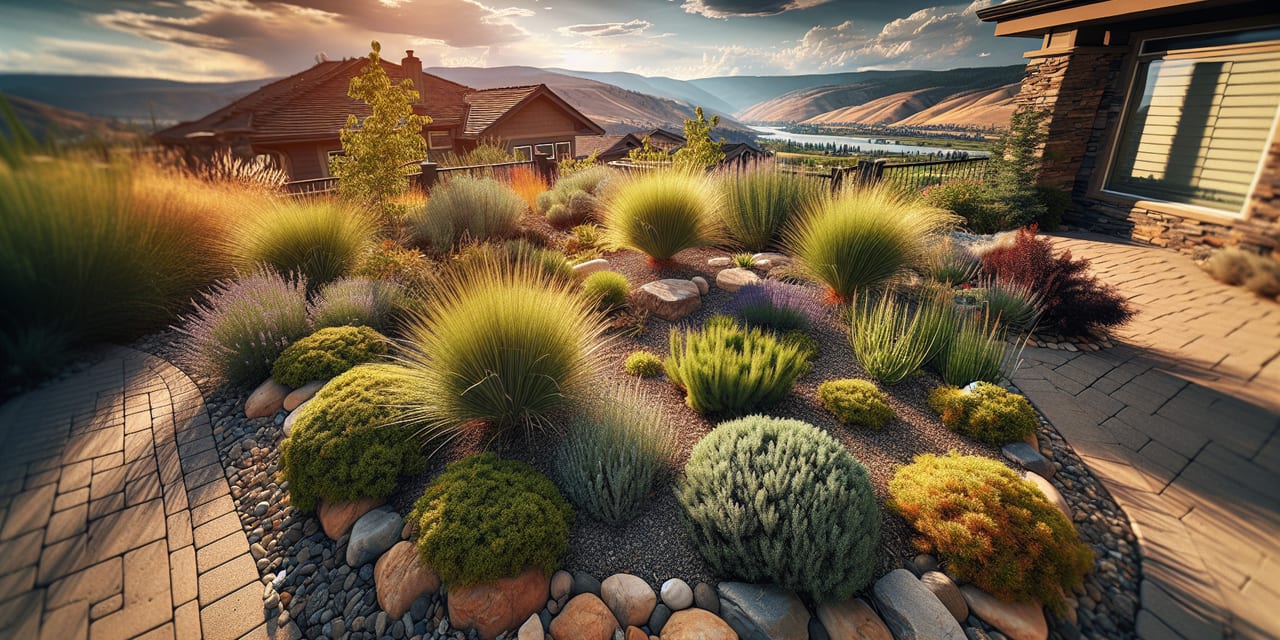
Mulch vs. Rock in the Okanagan: What Works Best for Kelowna Properties
Every Okanagan homeowner with a garden bed or landscaped area eventually faces the same decision: bark mulch or decorative rock? On the surface it seems like a style preference. In practice, the choice affects how much water your plants need, how much maintenance your yard requires over the next decade, and in some parts of Kelowna, it can affect your fire insurance situation. The Okanagan's semi-arid climate makes this decision more consequential than it would be in wetter parts of BC. Ground cover here is doing real work: reducing evaporation, moderating soil temperature, and in the case of rock, potentially creating a fire-smart buffer. Getting it wrong means either constantly fighting moisture loss or dealing with a ground cover that doesn't suit your plants. The direct answer is that rock and mulch each have clear use cases, and the right answer often involves both on the same property. Rock is the long-term low-maintenance choice that suits xeriscape plantings, driveways, and firebreak areas. Mulch is the better choice for vegetable gardens, established perennial beds, and trees where soil health and moisture retention matter more than longevity. This guide covers both options in enough depth to make a confident decision. For a quote on [mulch and drainage rock installation in Kelowna](/services/mulch-drainage-rocks/kelowna/), call Cool Runnings at (250) 307-9220.
Moisture Retention: The Critical Factor in the Okanagan
In a climate with 300 millimetres of annual precipitation and 2,000 hours of sunshine, what you put on top of your soil has a direct impact on your watering bill. Both mulch and rock reduce evaporation compared to bare soil, but they work differently.
Bark mulch retains moisture significantly better than rock. A 3-inch layer of wood chip or bark mulch acts as insulation, keeping the soil cooler and holding moisture for longer after a rain or watering. Studies consistently show mulched beds need 25 to 50 percent less water than un-mulched beds. In the Okanagan heat, that's a meaningful difference. During Stage 2 restrictions when you're watering your garden on alternate days, mulch buys your plants more time between waterings.
Rock, on the other hand, absorbs heat during the day and radiates it at night. In July, decorative rock in direct sun can reach 60 to 70°C on the surface. That heat transfers into the soil and can stress plant roots, especially for perennials and shrubs planted close to rock surfaces. The soil under rock does stay moister than bare soil because the rock acts as a barrier to evaporation, but the heat factor partially offsets that benefit.
For vegetable gardens and annual flower beds where consistent soil moisture is critical, mulch is the better choice by a clear margin. For xeriscape plantings with drought-tolerant natives (bunch grasses, sage, lavender, yarrow), rock is fine because those plants are adapted to hot, dry soil conditions.
If you're undecided about which direction fits your Kelowna garden, the planting and landscaping service can help you assess your plant selection alongside your ground cover choice.
In the Okanagan, a 3-inch mulch depth is the practical minimum for meaningful moisture retention. Less than that dries out quickly in summer heat. For raised vegetable beds, 4 inches of mulch or straw gives noticeably better moisture retention.
Longevity and Maintenance Over Time
Decorative rock installed correctly is essentially permanent. Kelowna homeowners who put in drainage rock or decorative gravel 20 years ago still have that same rock today. It doesn't decompose, it doesn't blow away in wind (if appropriately sized), and it doesn't need seasonal refreshing. The maintenance it does require is pulling weeds that germinate in soil that blows in on top of the rock, and occasionally raking it level after heavy rain shifts it around.
Bark mulch is a 2 to 3 year product in the Okanagan. UV exposure, heat, rain, and microbial activity break it down over time. Fine-shredded mulch breaks down faster than chunky wood chips. By year 2 or 3 you're topping up or replacing to maintain the depth and appearance you started with. Over a 10-year period, a mulched bed has been refreshed 3 to 5 times. Each refresh costs money for material and labour.
The total cost comparison over 10 years often flips the initial price difference. Rock costs $80 to $120 per yard installed and you don't buy it again. Mulch at $60 to $90 per yard gets purchased 3 to 5 times over the same period. For large areas, rock can be the cheaper long-term option despite higher upfront cost.
There's a caveat. As mulch breaks down it improves your soil. Organic matter from decomposing wood chips feeds soil biology, improves structure, and increases water-holding capacity. Rock provides none of that. Over 10 years, a well-mulched bed has measurably better soil than a rocked bed. If you have plants that care about soil quality, that difference is real.
Black landscape fabric under rock is commonly installed but is a long-term maintenance problem. It breaks down in 5 to 7 years, becomes impossible to remove, and weeds still find their way through. A 4-inch layer of properly sized rock on bare soil outperforms fabric-plus-rock for long-term weed suppression.
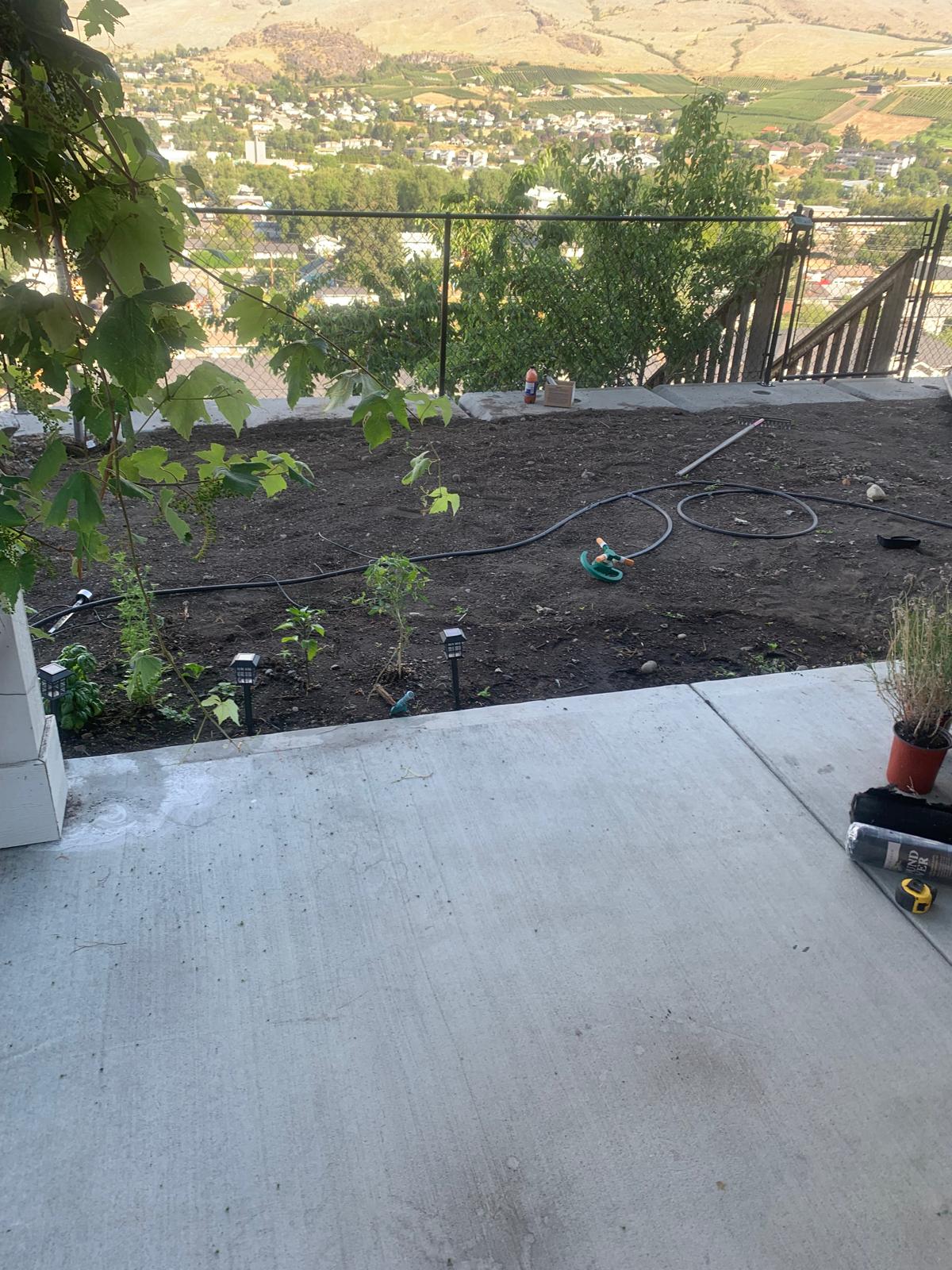 Before
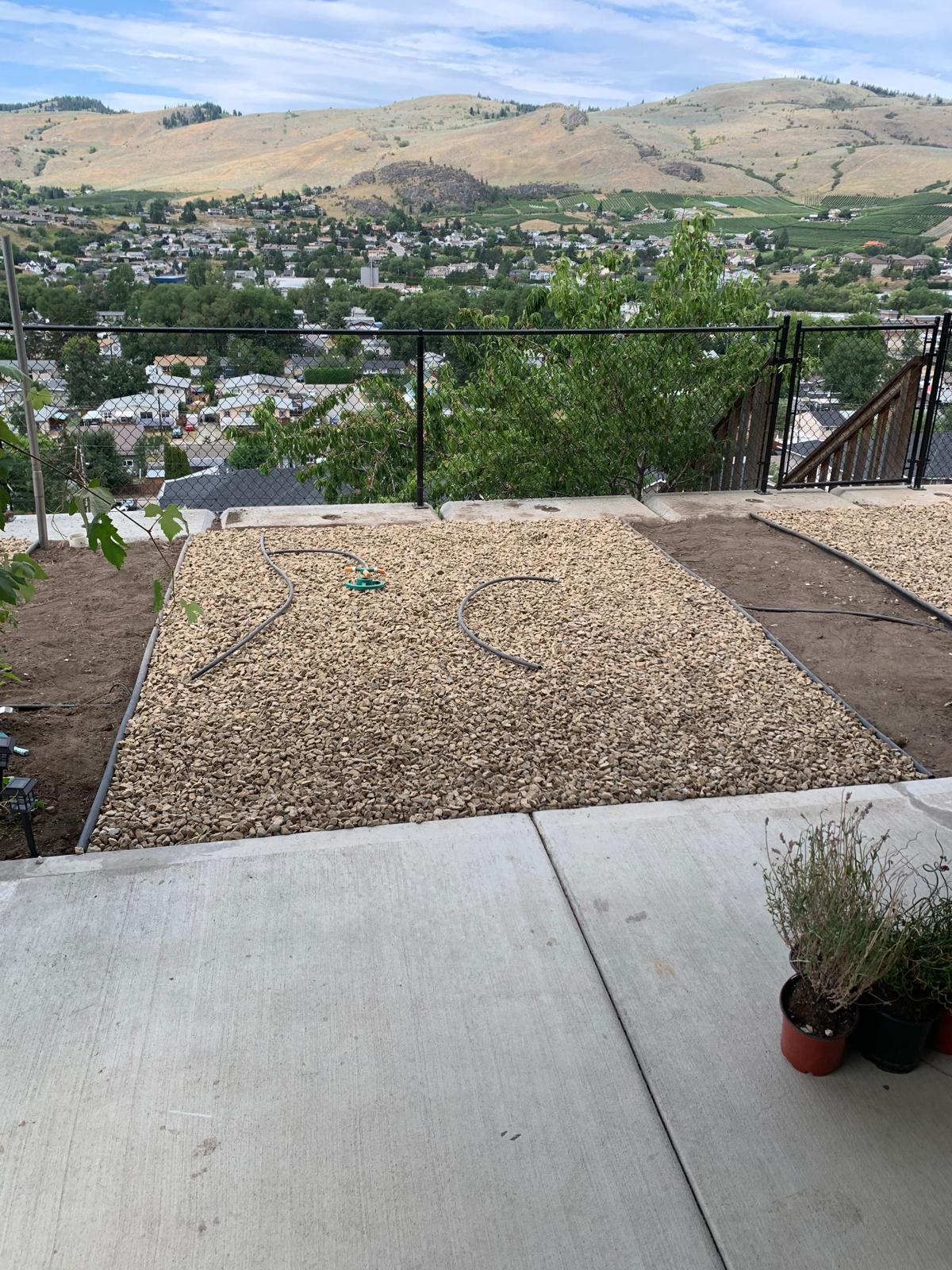 After
After
Fire Risk in Kelowna's WUI Zones
This is the factor that most online mulch-vs-rock guides skip entirely, but in Kelowna it's a genuine consideration. Large parts of Kelowna, West Kelowna, Lake Country, and the surrounding hillsides are classified as Wildland-Urban Interface (WUI) zones. Properties in these areas have real wildfire risk, and what you put in your yard affects how your home performs in a fire.
Bark mulch burns. Dry bark mulch in late July or August in Kelowna can ignite from an ember, and once lit it can carry fire toward a structure. The BC FireSmart program specifically recommends against wood mulch within 1.5 metres of any structure, and many WUI properties extend that guidance further.
Decorative rock is non-combustible and is the FireSmart-recommended ground cover for zones immediately adjacent to homes and decks. If you're in a WUI zone (which you can check through the City of Kelowna's fire risk mapping), the area within 10 metres of your house is called the Home Zone, and FireSmart guidelines call for non-combustible materials in this area.
This doesn't mean mulch is inappropriate everywhere on WUI properties. It means you think in zones. Rock within 10 metres of the structure, particularly under decks and adjacent to the foundation. Mulch further out in garden beds where the fire risk tradeoff is acceptable and the moisture benefit is worth it.
If your property is in a high-risk zone and you've been using bark mulch right up to your deck, that's worth changing. The mulch and drainage rock service can help you convert those areas to appropriate non-combustible ground cover.
Properties in Kelowna's WUI zones should avoid wood mulch within at least 1.5 metres of structures. Check the City of Kelowna's FireSmart resources for the specific guidelines that apply to your neighbourhood. Knox Mountain, Dilworth, and the Mission hillsides are commonly high-risk areas.
Cost Breakdown: Upfront and Long-Term
Material costs in the Kelowna area run roughly $80 to $120 per cubic yard for decorative rock (depending on type, size, and colour) and $60 to $90 per cubic yard for bark mulch or wood chips. Both prices include delivery but not installation labour.
For a typical 200 square foot garden bed at 3 inches of depth, you need approximately 1.9 cubic yards of material. At those rates, that's $152 to $228 for mulch or $152 to $228 for rock in material cost alone. The initial material cost is similar at this scale.
Installed cost (including labour to spread and edge) adds $30 to $60 per hour for a landscaping crew. A 200 square foot bed takes 1 to 2 hours to prep and fill. So expect $200 to $350 all-in for a smaller bed, whether you choose rock or mulch.
Where the economics diverge is over time. Rock is a one-time purchase. Mulch gets refreshed every 2 to 3 years. If you have 500 square feet of garden beds, that's roughly $400 to $600 in mulch every 2 to 3 years. Over a 10-year span you've spent $2,000 to $3,000 on mulch versus one purchase of $800 to $1,200 for rock. The math favours rock for low-priority areas where soil improvement isn't the goal.
For vegetable gardens, the calculus is different. The soil health benefits of decomposing mulch directly improve yields, so the ongoing cost has a return. Rock in a vegetable garden provides none of that.
River rock and local basalt from the Okanagan are often cheaper than imported decorative stone because transportation costs are lower. If appearance isn't the primary concern, ask about locally sourced material when getting a quote.
Appearance and Design Considerations
Rock gives a clean, structured look that many Kelowna homeowners associate with low-maintenance landscaping. Decomposed granite, river rock, and basalt all read as intentional and polished in a way that suits the Okanagan's natural aesthetic. Rock doesn't fade significantly in UV light, though some coloured decorative stone loses vibrancy over several years.
Bark mulch has a more naturalistic, garden-focused appearance. Dark brown hemlock bark or cedar chips read as traditional garden mulch and complement densely planted perennial beds well. The aesthetic wears slightly as mulch fades from exposure. Fresh mulch looks noticeably better than 2-year-old mulch that hasn't been refreshed.
For front yards visible from the street, both can look excellent when done right. The combination approach works particularly well: rock borders or pathways framing mulched planting beds. This gives you the maintenance benefits of rock in low-plant zones and the moisture benefits of mulch where plants are dense.
Colour consistency matters more with rock because it's permanent. A rock colour that looks good in the supplier's yard may read differently in your specific yard at different times of day. Getting a small sample to look at on-site before committing to a large order is worth the effort.
For formal front yard designs, river rock or decomposed granite often looks more polished. For naturalistic, cottage-style gardens, bark mulch reads better. Neither is universally superior on aesthetics alone.
If you're using decorative rock near a pool or water feature, avoid lighter-coloured stones that show algae staining easily. Darker basalt and charcoal coloured rock holds its appearance better in wet conditions.
Which to Choose for Your Okanagan Property
The direct recommendation based on what actually works in Kelowna's climate and fire conditions:
Choose rock for areas within 10 metres of your home if you're in a WUI zone. Choose rock for driveways, pathways, and any low-maintenance area where plant health isn't the priority. Choose rock for xeriscape designs with drought-tolerant native plantings. Choose rock if you want the lowest long-term maintenance burden and are willing to pay a higher upfront cost.
Choose mulch for vegetable gardens and annual flower beds where consistent moisture and soil health matter. Choose mulch for established perennial beds and trees where the organic matter from decomposition feeds soil life. Choose mulch if you're planting new trees and shrubs and want to support root establishment. Choose mulch if you're in an area with established fire protection and your beds are away from structures.
For most Kelowna properties, the best answer is both. Rock near the house and in low-traffic low-plant zones. Mulch in the working garden areas. That approach gives you the FireSmart safety and low maintenance of rock where it matters, and the soil health and moisture benefits of mulch where plants need it.
Call Cool Runnings at (250) 307-9220 or contact us online to talk through what makes sense for your specific yard and get a quote on mulch and rock installation.
Some strata properties and city bylaws in Kelowna specify permitted ground cover types, particularly in newer developments. Check your strata rules or city guidelines before installing a large rock feature.
How to Pick the Right Ground Cover for Your Okanagan Property
A straightforward framework for deciding between bark mulch and decorative rock for Kelowna and Okanagan landscaping projects.
Common Questions
Is bark mulch a fire hazard in Kelowna? ▾
How much rock do I need for a garden bed? ▾
How often does mulch need to be replaced in the Okanagan? ▾
What type of rock is best for Okanagan landscaping? ▾
Can I put rock over existing mulch? ▾
Ramoy Brissett is the owner and lead landscaper at Cool Runnings, which he founded in 2017. With 9+ years of hands-on experience working in the Okanagan Valley's unique semi-arid climate, he personally oversees every job the company takes on. His expertise covers lawn care, sod installation, drought-tolerant planting, mulch and drainage, and full-yard renovations across Kelowna, West Kelowna, Vernon, Penticton, and Salmon Arm.
More about Ramoy →