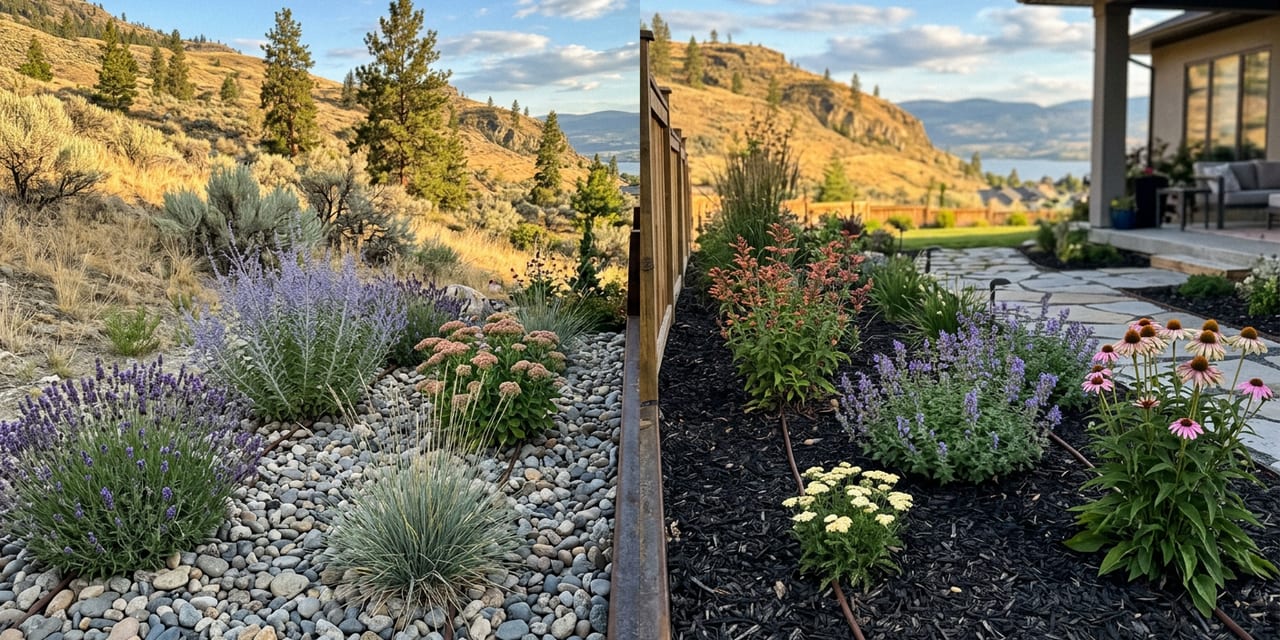
Mulch vs. Rock for Okanagan Gardens: An Honest Local Breakdown
Search "mulch vs rocks" online and you'll find plenty of opinions, most of them written for gardens in Ontario or the Pacific Northwest. The Okanagan is a different situation. We're semi-arid, we get summer temperatures that push into the high 30s, and in many parts of Kelowna, wildfires aren't a distant concern, they're something homeowners plan around. Both bark mulch and river rock have their place here, but the decision isn't as simple as picking the one that looks good.
The Okanagan Is Not Like the Rest of Canada
Most of Canada gets enough rain that moisture retention is a secondary concern and the main job of mulch is aesthetics and weed suppression. In the Okanagan, we average around 300mm of rainfall per year. That's semi-arid. The soil dries out fast in summer, water restrictions kick in every June, and plants that thrive elsewhere simply don't make it here without extra support.
At the same time, Kelowna and the surrounding communities sit in what's called a Wildland-Urban Interface (WUI) zone. Large fires have burned close to the city before, and local FireSmart awareness has changed how many homeowners think about what's sitting within a few metres of their house.
These two factors, extreme dry heat and wildfire proximity, shape the mulch-vs-rock decision in ways that generic gardening content doesn't address. The mulch and rock services we do across the Okanagan look very different from one property to the next because of these variables.
The Case for Bark Mulch
Bark mulch does several things well. It retains soil moisture, which is genuinely valuable in an Okanagan summer when the top layer of soil dries out within a day or two of watering. A 7 to 10cm layer of bark mulch can reduce soil moisture evaporation by a meaningful amount, which means less frequent irrigation and lower water bills.
It also improves soil over time. As organic mulch breaks down, it adds organic matter that benefits soil structure and microbial health. In the Okanagan's sandy loam soils (common in many Kelowna neighbourhoods), this matters.
Bark mulch is generally the more affordable option upfront. For garden beds around Kelowna, fresh bark mulch installed typically runs less per square metre than river rock, especially for larger areas. The catch is that it needs refreshing. A good bark mulch installation looks great in spring and starts looking tired by year two as it greys and compresses. Plan to top it up every one to two years.
Pest-wise, bark mulch can create habitat for earwigs, slugs, and moisture-seeking insects if it's kept thick and wet right up against plant stems. Keep it pulled back a few centimetres from the base of each plant.
Hemlock or fir bark tends to last longer than cedar in Okanagan conditions and is less likely to blow around in the wind that comes through the valley in spring.
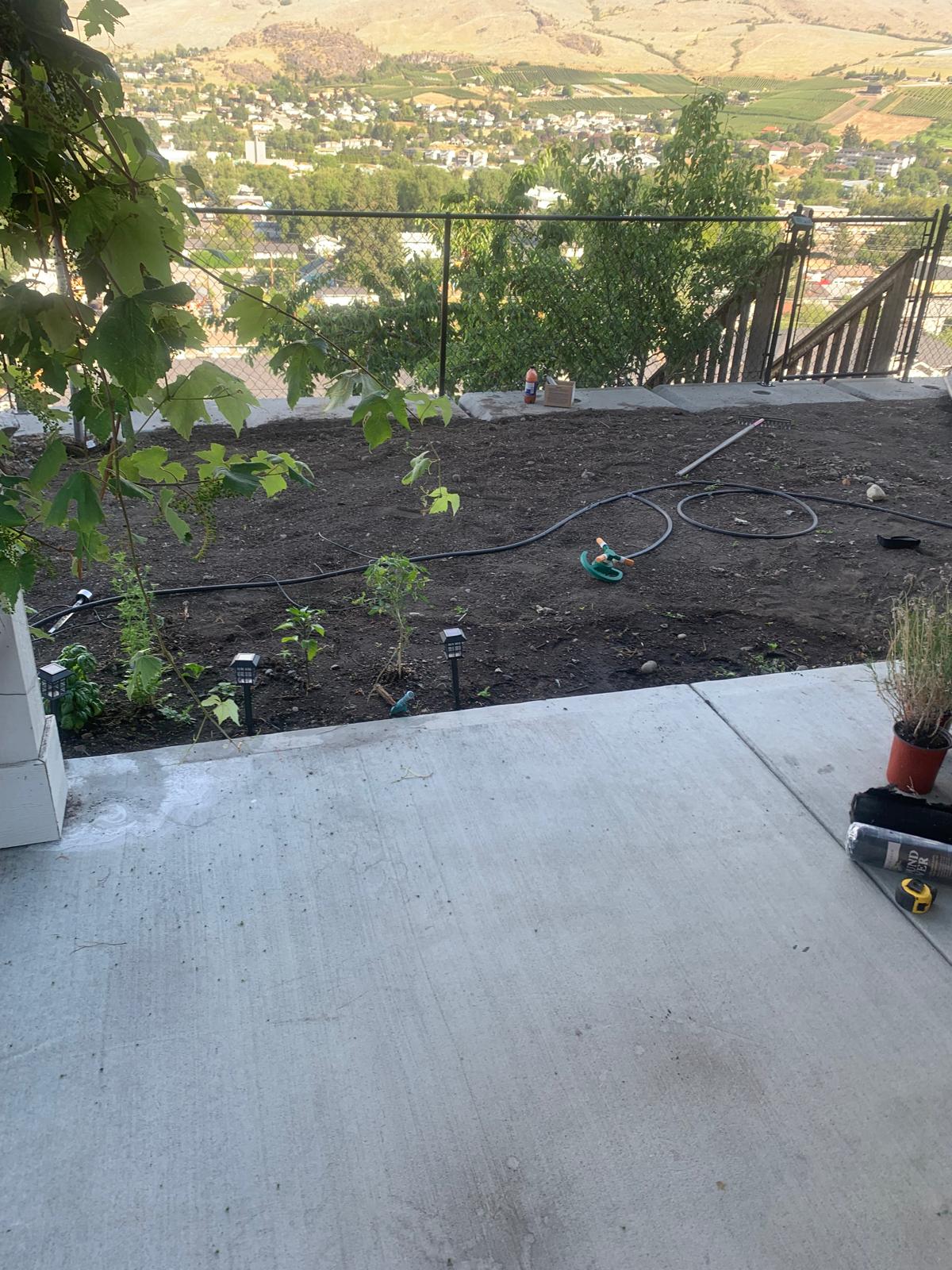 Before
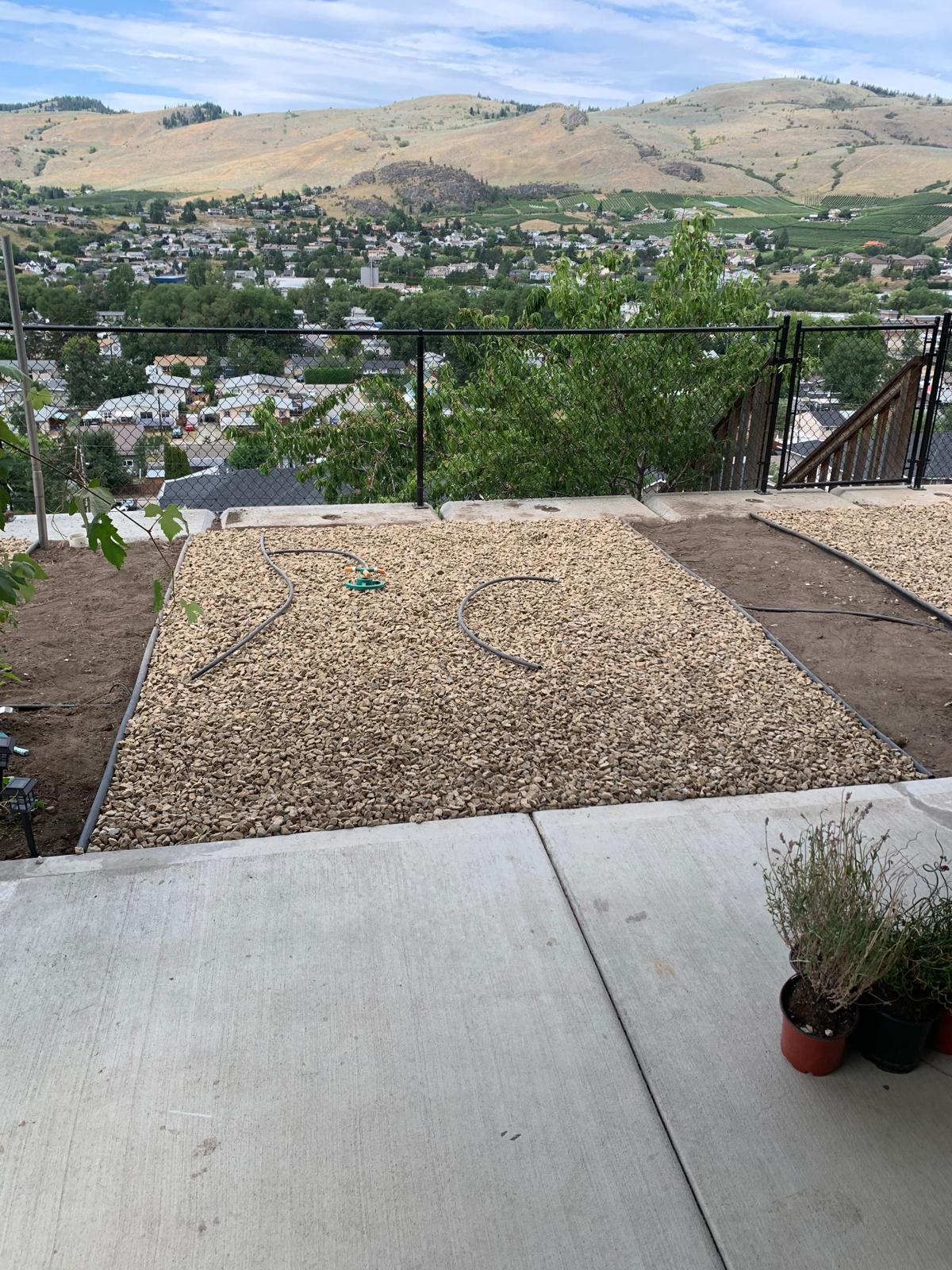 After
After
The Case for River Rock and Drainage Rock
River rock and crushed drainage rock are permanent. Once it's installed, you're not coming back to refresh it every two years. For homeowners who don't want ongoing garden maintenance, or who are converting a yard to a low-maintenance setup, rock is often the right call.
Rock drains well. In areas where standing water is a concern or where soil drainage is poor, a layer of rock keeps the surface open and prevents the mud and moss problems that bark mulch can develop in shaded areas. For properties near the lake or in lower-lying areas, drainage rock does a job bark mulch can't.
Weed suppression with rock depends heavily on what's underneath it. Rock alone isn't a weed barrier. Rock over quality weed fabric, properly overlapped and pinned, dramatically reduces weed pressure for years. Without fabric, you'll be pulling weeds out of rock for as long as you own the house, which is no fun.
The upfront cost is higher for rock, particularly for larger coverage areas. But amortized over ten years versus refreshing bark mulch every two years, the math often favours rock for low-maintenance landscaping in areas away from wildfire risk. For mulch and rock installation in the Okanagan, we'll run through the numbers with you.

The Wildfire Consideration
This is the factor almost no gardening guide talks about, and in the Okanagan it's one of the most important decisions a homeowner can make.
Kelowna and surrounding communities are in a Wildland-Urban Interface zone. FireSmart BC's guidelines recommend keeping the first 1.5 metres around any structure free of combustible materials. Bark mulch is combustible. In a wildfire scenario with embers landing, a layer of bark mulch next to a deck, fence, or house wall becomes a direct ignition path.
River rock, crushed rock, and decomposed granite are non-combustible. FireSmart BC specifically recommends using these materials in the immediate zone around your home.
This isn't hypothetical in the Okanagan. Neighbourhoods like Mission Hill, McKinley Landing, Dilworth Mountain, Glenmore, and Crawford Estates back onto dry hillsides and forested areas where interface fire risk is elevated. Homeowners in these areas have real reason to think about what's within a metre and a half of their home's foundation.
The practical recommendation: use rock in the immediate zone around your house (within 1.5 to 3 metres of any structure), and use bark mulch in beds further into the yard if you want its soil and moisture benefits. You can have both.
FireSmart BC recommends keeping the first 1.5m around your home free of combustible materials, including bark mulch. In Kelowna's WUI neighbourhoods, this is worth taking seriously, not just for insurance purposes, but for your home's actual fire resistance.
What I Actually Recommend
After doing mulch and rock work across Kelowna and the Okanagan for years, here's the honest answer: it's not one or the other. The right choice depends on where on your property you're working and what matters most to you.
Within 1.5 to 3 metres of your house, deck, or fence: use river rock or drainage rock. Full stop. The fire risk isn't worth saving a few dollars on bark mulch in that zone.
In garden beds away from structures, in a front yard parkway, or around trees: bark mulch is usually the better choice. It does more for your plants, it's friendlier on the budget, and the fire risk in the middle of the yard (away from structures) is much lower.
For front yards in neighbourhoods like Dilworth, McKinley, or Mission where fire-awareness is high: a full rock conversion with drought-tolerant plants is increasingly popular and looks genuinely good when done right.
If maintenance is your main concern and budget isn't: rock everywhere with weed fabric underneath.
If plant health and soil quality matter most and you're not in a WUI zone: bark mulch in the beds, refreshed every year or two, is hard to beat.
We're seeing more Kelowna homeowners in hillside neighbourhoods switch to full rock or decomposed granite near their homes after the past few years of fire activity in the region. It's a smart long-term investment.
Cost Breakdown in the Okanagan
Prices vary by material, quantity, access, and what's being removed, but here are typical ranges for the Okanagan.
Bark mulch (hemlock or fir), installed: typically $80 to $120 per cubic yard including labour and delivery. A standard front garden bed might need two to four yards. The material cost is lower, but you're paying for it again every one to two years.
River rock or drainage rock, installed: typically $150 to $250 per cubic yard including labour and delivery. Heavier and more labour-intensive to install. Higher upfront, but it doesn't come back to you on a recurring basis.
Weed fabric adds to either option. Quality landscape fabric (not the cheap stuff that disintegrates in two years) runs $0.50 to $1.50 per square metre installed.
For a full mulch or rock installation in Kelowna, we'll give you a clear quote based on your actual area and material choice. There are no hidden delivery fees or material markups you won't see coming.

Maintaining Either Over Time
Bark mulch maintenance is simple but recurring. Every spring, rake back what's left from last year, pull any weeds that came through, and add a fresh layer to bring the depth back to 7 to 10cm. This typically takes an hour or two for an average garden and a truck delivery of material. Some homeowners enjoy it; others find it a chore.
Rock maintenance is minimal but not zero. Weeds will eventually find their way through fabric (especially wind-blown seeds that settle in the rock and germinate on the surface). Pulling these is easier than hand-weeding in bark mulch because nothing is being disturbed. A periodic rinse-down with a hose keeps river rock looking clean, particularly in areas that get dust from nearby roads or construction.
Both materials benefit from a yearly yard tidy in spring. Edging tends to creep over time, and refreshing the clean lines between lawn and bed makes a real difference in how the whole yard looks.
If you're not sure what you have, what you need, or what your options cost, get in touch and we'll walk through it with you on site.
How to Apply Bark Mulch Properly
Getting bark mulch right means more than dumping a load in the garden. Proper installation prevents weeds, protects plants, and keeps your beds looking good.
Common Questions
Do rocks work better than mulch in Okanagan gardens? ▾
Which is cheaper, rock or mulch in Kelowna? ▾
Is bark mulch a fire risk in Kelowna? ▾
How deep should I put bark mulch? ▾
Will rocks stop weeds in my garden? ▾
Can I use both mulch and rock in the same yard? ▾
Ramoy Brissett is the owner and lead landscaper at Cool Runnings, which he founded in 2017. With 9+ years of hands-on experience working in the Okanagan Valley's unique semi-arid climate, he personally oversees every job the company takes on. His expertise covers lawn care, sod installation, drought-tolerant planting, mulch and drainage, and full-yard renovations across Kelowna, West Kelowna, Vernon, Penticton, and Salmon Arm.
More about Ramoy →